
Huawei Unveils Upgraded Stellar AI Network to Support Secure Connectivity in the Agentic AI Era
SHANGHAI, China — September 19, 2026 — Huawei has introduced an upgraded version of its Stellar AI Network, designed to address the rapidly changing networking requirements created by the expansion of artificial intelligence and emerging agentic AI applications.
The upgraded solution was unveiled at HUAWEI CONNECT 2026, where Huawei presented a networking architecture focused on combining intelligent connectivity with security, while improving computing efficiency, enabling lossless data transmission and accelerating deployment.
Huawei said the upgraded Stellar AI Network is intended to help organizations unlock greater computing performance while maintaining secure and reliable AI services as AI workloads continue to expand.
According to the company, daily token usage has increased 260-fold within a single year, reflecting the rapid growth of AI applications and the corresponding demand for networking infrastructure capable of handling increasingly intensive workloads.
The latest Stellar AI Network portfolio covers three key environments: Stellar AI Fabric, Stellar AI WAN and Stellar AI Campus.
Stellar AI Fabric 2.0: Connecting AI Computing at Scale
Huawei’s Stellar AI Fabric 2.0 focuses on improving the efficiency, reliability and security of networks supporting AI computing clusters.
The company has introduced its SF9300 UBG series switches, which can work with Ascend A5/A6 processors to create an integrated UBG network solution for connecting computing resources.
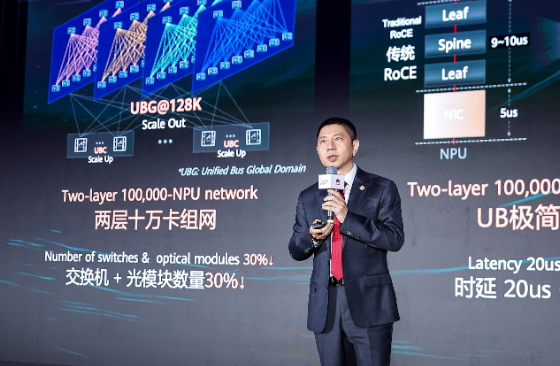
Its two-layer, multi-plane architecture removes the traditional Core Layer, which Huawei says can reduce network deployment costs by as much as 30%.
A unified protocol architecture is also designed to reduce end-to-end latency from 20 μs to 11 μs.
Huawei has incorporated Link-Layer Retransmission (LLR) technology to maintain lossless packet transmission during periods of unstable connectivity. The company says this can reduce annual cluster downtime by as much as 100 hours.
Another addition is the CloudEngine XH9300-EN NPO series switch, developed entirely in-house by Huawei.
The system incorporates three key design features.
First, a centralized light-source architecture reduces connection power consumption from 1,000 W to 600 W, potentially lowering electricity costs for AI clusters.
Second, its Near-Packaged architecture reduces optical-electrical conversion latency by 180 ns, which Huawei says improves single-node latency performance by 26%.
Third, a replaceable Snap-Fit design enables components to be changed directly on site. Huawei says this can reduce recovery time following equipment failures from several days to only a few hours.
Three-layer protection for AI infrastructure
Security is another core component of Stellar AI Fabric 2.0.
Huawei’s three-layer security architecture is designed to address threats including unauthorized use of computing resources, malicious instruction manipulation and model poisoning.
The Network Guardrail incorporates a built-in cryptocurrency-mining detection model, with Huawei reporting detection accuracy of up to 95% and the ability to block malicious traffic within milliseconds.
The Agent Guardrail is designed to identify prompt-injection attacks with reported accuracy of 95% and latency below 150 ms.
Meanwhile, the Host Guardrail monitors potentially malicious processes in real time while using less than 1% of CPU resources, according to Huawei.
In customer-site deployments, Huawei says the system identified 415 high-risk vulnerabilities and detected 322 threat events during the first seven days.
The company describes the approach as using AI-based technologies to protect AI infrastructure itself, with the goal of ensuring that AI-generated tokens and services can be produced securely.
Stellar AI WAN: Extending AI Computing Across Long Distances
Huawei’s Stellar AI WAN is designed to address the challenges organizations face when distributing AI computing resources across geographically separated locations.
Cross-region AI workloads can encounter performance degradation, high infrastructure costs and expensive dedicated network connections.
Huawei says Stellar AI WAN can support remote computing connections spanning more than 1,000 kilometers while maintaining lossless data transmission.
Its Starnet Lossless algorithm is designed to minimize data loss during transmission, with Huawei reporting remote computing efficiency of more than 95%.
The solution also uses XH computing network equipment equipped with model-layering algorithms. Initial and final stages of model processing can be performed directly at the application sites, while only high-dimensional vector data is transmitted across the network.
This approach is intended to keep raw data within the organization while reducing xPU requirements for branch deployments by up to four times.
At the same time, computing and data transmission can take place concurrently, which Huawei says can reduce idle bandwidth time by more than 80% and cut overall bandwidth requirements by up to five times.
Multi-layer WAN security
Stellar AI WAN also incorporates Huawei’s multi-dimensional WAN security technologies to address emerging threats, including APT and HNDL attacks.
At the device level, an integrated security board is designed to block intrusions in real time. Huawei says it can trace threats within minutes with accuracy above 95%, while visualizing attack paths across as many as 100 hops.
At the link level, built-in QKD technology provides quantum-level security without requiring additional equipment. Huawei says the approach can reduce deployment costs by more than 60% while supporting transmission distances of up to 80 kilometers.
At the network level, APN6 data-boundary allocation technology enables organizations to control traffic routing throughout the network, providing additional protection for high-value and sensitive data.
Stellar AI Campus Network: AI-Driven Operations and Security
Leon Wang, President of Huawei’s Data Communication Product Line, delivering a speech
Huawei’s third major component, the Stellar AI Campus Network, focuses on enterprise campus environments where AI agents and connected devices are becoming increasingly common.
Huawei expects enterprise adoption of AI agents to reach 50% this year, creating new demands on traditional network operations and maintenance.
Conventional approaches may struggle to provide continuous 24-hour monitoring and rapid fault recovery. Huawei therefore has expanded its AI-powered network automation capabilities across data, models and operational tools.
Its proprietary network-awareness technology can collect more than 25 types of specialized data, with sampling intervals as short as 100 ms. Huawei says this allows the system to identify subtle network abnormalities more precisely.
The Deep Causal Pruning (DCP) algorithm is designed to improve AI model efficiency, reducing deep reasoning errors by more than 20% while achieving up to 95% accuracy in identifying the causes of network failures, according to the company.
Huawei’s iFlow 2.0 distributed simulation technology continuously monitors processing paths around the clock.
The company says this enables network operations to become increasingly AI-driven, reducing mean time to repair (MTTR) to less than five m
Via: Technology News PH
 EyeROV Brings Indian Underwater Robotics to the Global Stage at BRICS SummitEyeROV at the BRICS Summit Exhibition (PRNewsfoto/EyeROV)
  Meet LG’s Seven Standout Innovations at IFA 2026
  Transport & Logistics Philippines 2026 Brings Global Supply Chain Solutions to Manila
  Singapore’s Estha launches a private AI workforce for the Mac
  ManageEngine Launches a Developer Ecosystem To Supercharge Its Platforms
  LG ELECTRONICS BRINGS HIGH-EFFICIENCY LIVING TO MORE CONSUMERS AT IFA 2026
  Transport & Logistics Philippines 2026 Opens, Bringing Global Supply Chain Solutions to the Philippines